110 pounds into kilos conversion essentials explained
Table of Contents
- Understanding Weight Conversion Basics: Pounds to Kilograms
- Mathematical Derivation of the Pound-to-Kilogram Conversion
- Comparison Table: Practical Applications of Pound-to-Kilogram Conversion
- Step-by-Step Conversion of 110 Pounds to Kilograms
- Critical Fields Relying on Accurate Weight Conversion
- Flowchart Structure for Weight Conversion Process
- Practical Applications of Converting 110 Pounds to Kilograms
- Industries and Professions Requiring 110 lbs to kg Conversion
- Case Study: Fitness Trainer’s Use of 110 lbs to kg Conversion
- Step-by-Step Guide to Converting 110 lbs to kg Using Online Calculators
- Weight Classification Comparison: Pounds vs. Kilograms for 110 lbs
- Tools and Methods for Accurate Conversion of 110 Pounds to Kilograms
- Comparison of Conversion Tools: Accuracy, Usability, and Application
- Manual Conversion: Step-by-Step Calculation
- Building a Custom Conversion Tool with Python
- Verification and Troubleshooting Conversion Results
- Cultural and Regional Perspectives on Weight Measurement
- Historical and Political Roots of Pound vs. Kilogram Dominance
- Geographical Breakdown: Where Pounds Persist Beyond the U.S.
- Cultural Perceptions of Weight in Pound vs. Kilogram Regions
- Language-Specific Terminology for Weight Units
- Challenges for Travelers and Expats in Interpreting Weight Instructions
- Expert Insights: Navigating Weight Conversions Across Borders
- Advanced Topics: Precision, Science, and Everyday Use in Weight Conversion
- Scientific Foundations of the Conversion Factor and Future Redefinitions
- Precision Requirements Across Industries: From Fitness to Aerospace
- Real-World Example: Critical Precision in Aerospace Engineering
- Flowchart: Selecting the Appropriate Precision Level for Weight Conversion
- Common Mistakes and How to Avoid Them in Converting 110 Pounds to Kilograms
- Five Common Errors in Pound-to-Kilogram Conversions
- Step-by-Step Verification for Accurate Conversions
- Scenario-Based Conversion Exercise
- Psychological Impact of Weight Perception Across Units
- FAQ: Addressing Persistent Misconceptions
Everyday decisions—from tracking fitness progress to shipping international parcels—often hinge on the precise conversion of 110 pounds into kilograms, a measurement bridging imperial and metric systems. Missteps here can distort weight loss goals, inflate shipping costs, or even compromise medical dosages, yet many overlook the nuances behind this seemingly simple calculation. The discrepancy between 110 lbs and its metric equivalent, 49.895 kg, reveals deeper questions: Why do industries demand six-decimal precision in aerospace while rounding to one decimal suffices for gym scales? And how does a historical relic like the pound persist in a world dominated by kilograms?
The answer lies in understanding the science, tools, and cultural quirks surrounding weight conversion—a process fraught with potential pitfalls. From the fitness trainer adjusting client benchmarks to the logistics coordinator recalculating freight fees, the stakes of accuracy are undeniable. This guide dissects the conversion formula, exposes common errors that cost businesses and individuals alike, and explores why 110 pounds might feel lighter in theory than its 49.9 kg reality. Whether you’re a data-driven professional or a traveler navigating luggage limits, mastering this conversion unlocks clarity in a globally fragmented measurement landscape.
Understanding Weight Conversion Basics: Pounds to Kilograms
The transition between imperial and metric systems remains a critical skill in globalized fields where precision and standardization are paramount. The pound (lb) and kilogram (kg) represent two fundamental units of mass, each rooted in distinct historical and scientific traditions. While the kilogram, as the base unit of mass in the International System of Units (SI), traces its origins to the French Revolution and the kilogram prototype (IPK) established in 1799, the pound has a more complex lineage. Derived from ancient Roman units like the libra, the pound evolved through medieval European trade systems before being standardized in the UK’s Weights and Measures Act of 1824. The modern international avoirdupois pound, adopted in 1959, defines 1 pound (lb) as exactly 0.45359237 kilograms, a conversion factor derived from the metric system’s adoption of the gram and its multiples.
This precise relationship ensures consistency across scientific, industrial, and commercial applications. Below, the mathematical derivation and practical implications of this conversion are explored, alongside tools to apply it accurately in diverse contexts.

Mathematical Derivation of the Pound-to-Kilogram Conversion
The conversion between pounds and kilograms relies on a fixed ratio established by the international community to harmonize trade and measurement standards. The formula is derived from the definition:
1 lb = 0.45359237 kg
This value originates from the 1959 international agreement, which redefined the pound to align with the metric system’s gram-based units. The conversion process involves multiplying the weight in pounds by the fixed factor:
Weight in kg = Weight in lbs × 0.45359237
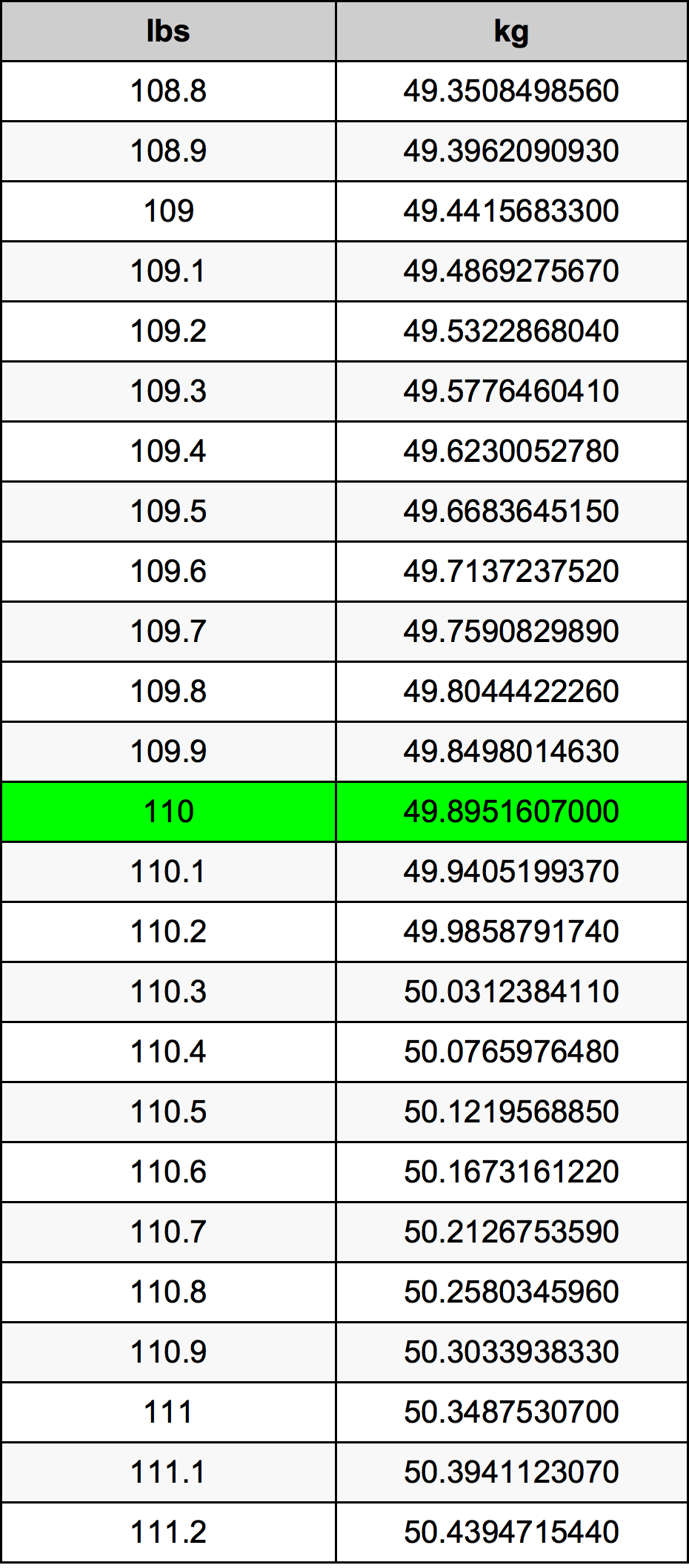
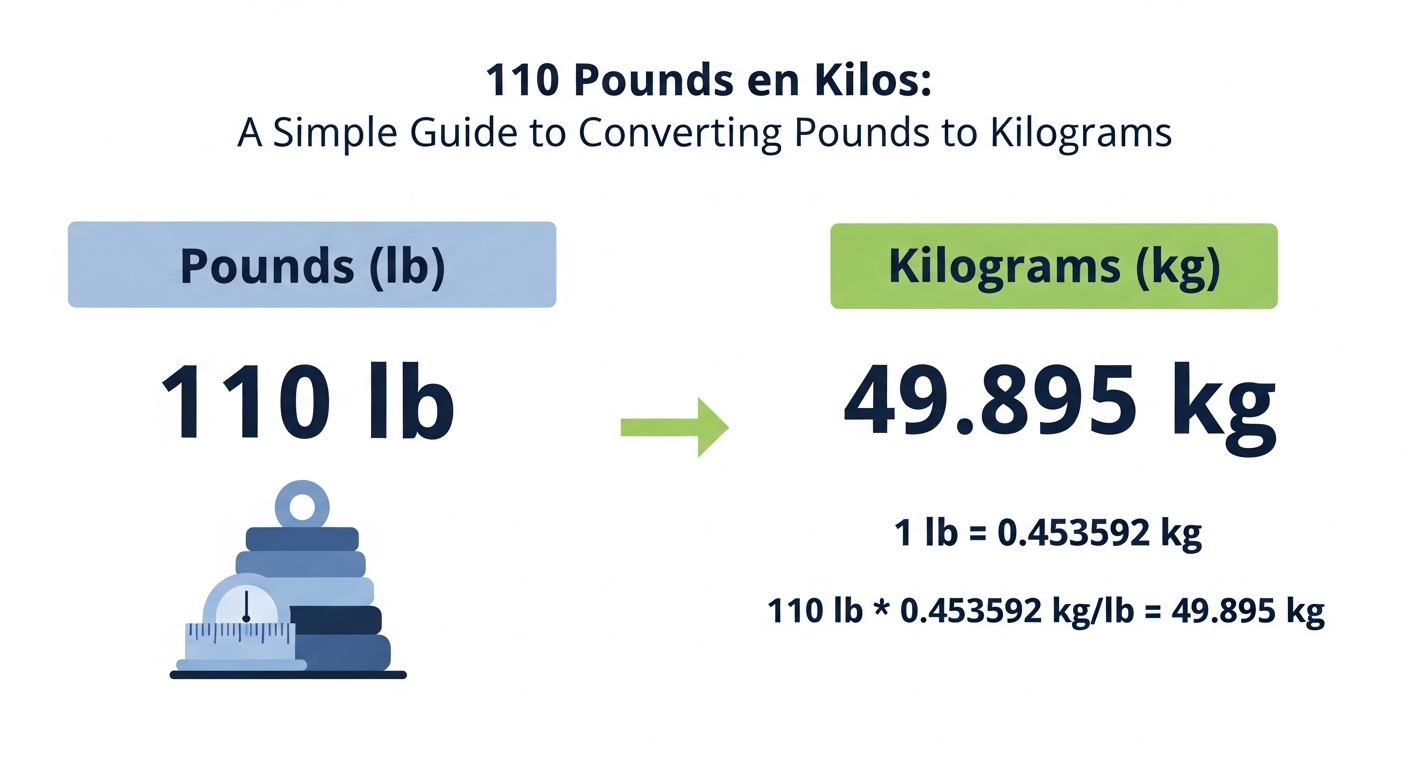
For example, converting 110 lbs requires multiplying 110 by 0.45359237, yielding 49.8951607 kg. However, practical applications often demand rounding to two decimal places (49.90 kg), balancing precision with usability. The discrepancy between exact and rounded values highlights the importance of context—fields like pharmaceutical dosing prioritize exactness, while fitness tracking may accept approximations.
Comparison Table: Practical Applications of Pound-to-Kilogram Conversion
The versatility of weight conversion spans industries where imperial and metric units coexist. Below is a structured table illustrating conversions for common weights, their exact and rounded equivalents, and real-world applications:
| Weight in Pounds (lbs) | Exact Conversion to Kilograms (kg) | Rounded Conversion (2 Decimal Places, kg) | Common Practical Applications |
|---|---|---|---|
| 50 lbs | 22.6796185 kg | 22.68 kg | Fitness benchmarks (e.g., body weight for exercise plans), shipping limits for small packages. |
| 110 lbs | 49.8951607 kg | 49.90 kg | Medical weight classifications (e.g., BMI calculations), luggage allowances on international flights. |
| 220 lbs | 99.79032 kg | 99.79 kg | Aviation fuel calculations, industrial material handling (e.g., cargo weight restrictions). |
| 500 lbs | 226.796185 kg | 226.80 kg | Shipping and logistics (e.g., freight weight declarations), automotive spare parts specifications. |
The table underscores how conversion accuracy varies by application. For instance, a 110 lb individual’s weight in kilograms (49.90 kg) is critical for healthcare providers calculating Body Mass Index (BMI), where even minor deviations could affect diagnosis. Conversely, rounded values suffice for general fitness tracking or luggage declarations, where precision beyond two decimal places is unnecessary.
Step-by-Step Conversion of 110 Pounds to Kilograms
Converting 110 lbs to kilograms involves a straightforward yet precise calculation. Below is the breakdown:
1. Identify the Conversion Factor: Use the exact value 1 lb = 0.45359237 kg. 2. Multiply the Weight by the Factor:
110 lbs × 0.45359237 kg/lb = 49.8951607 kg
3. Assess Rounding Needs: - Exact Value: 49.8951607 kg (used in scientific or medical contexts). - Rounded to 2 Decimal Places: 49.90 kg (sufficient for most practical purposes). 4. Potential Errors: Using an approximate factor (e.g., 0.454 kg/lb) introduces a 0.02% error, negligible for casual use but critical in fields like aerospace engineering, where even minor discrepancies can compound in safety calculations.
For manual calculations, breaking the multiplication into simpler steps reduces errors: - Multiply 100 lbs × 0.45359237 kg = 45.359237 kg. - Multiply 10 lbs × 0.45359237 kg = 4.5359237 kg. - Sum the results: 45.359237 kg + 4.5359237 kg = 49.8951607 kg.
Critical Fields Relying on Accurate Weight Conversion
Industries where safety, compliance, or financial stakes demand precision treat weight conversion as a non-negotiable standard. Below are key sectors and their dependencies:
- Healthcare: Medication dosages, particularly for children or geriatric patients, often rely on metric units. A 110 lb (49.90 kg) patient’s prescribed drug dose in milligrams per kilogram must account for exact weight to avoid under- or overdosing. The U.S. Food and Drug Administration (FDA) mandates metric measurements for all pharmaceutical labels to prevent such errors.
- Aviation: Aircraft weight limits, including payload and fuel calculations, use kilograms for international compliance. A miscalculation of 110 lbs (49.90 kg) as 50 kg could lead to unsafe takeoff conditions, as modern planes operate within tight weight margins. The International Civil Aviation Organization (ICAO) enforces metric standards to ensure global consistency.
- International Trade: Customs declarations and shipping contracts often require weights in kilograms for tariffs and logistics. A shipment labeled as 110 lbs (49.90 kg) must match the metric equivalent to avoid delays or penalties. The World Customs Organization (WCO) standardizes these conversions to streamline cross-border transactions.
- Engineering and Manufacturing: Prototypes and components are frequently designed using metric units, while suppliers in the U.S. may provide specifications in pounds. Converting 110 lbs (49.90 kg) for a machine part ensures compatibility in assembly lines, where tolerances are measured in fractions of a millimeter.
Flowchart Structure for Weight Conversion Process
A visual flowchart clarifies the decision-making process for converting pounds to kilograms, accounting for precision needs. Below is the proposed structure:
1. Start: Input weight in pounds (e.g., 110 lbs). 2. Decision Point 1: Is exact conversion required? - Yes: Proceed to multiply by 0.45359237 kg/lb (e.g., 110 × 0.45359237 = 49.8951607 kg). - No: Proceed to rounded conversion. 3. Decision Point 2: Round to how many decimal places? - 2 Decimal Places: Round 49.8951607 kg to 49.90 kg. - Other Precision: Apply additional rounding rules (e.g., 4 decimal places for scientific use). 4. Output: Display result with unit (kg) and context (e.g., "Medical: 49.90 kg"). 5. End: Verify result against application-specific standards
Practical Applications of Converting 110 Pounds to Kilograms
Accurate weight conversion between pounds (lbs) and kilograms (kg) is essential in various professional and everyday scenarios, ensuring precision in health assessments, logistics, and commercial transactions. Converting 110 pounds to kilograms (approximately 49.9 kg) plays a critical role in industries such as fitness training, clinical nutrition, e-commerce shipping, and international trade. Professionals in these fields rely on this conversion to meet regulatory standards, optimize performance, and streamline operations. Below are key applications where understanding this conversion is indispensable, along with actionable insights and comparative analyses.
Industries and Professions Requiring 110 lbs to kg Conversion
Conversions between pounds and kilograms are particularly relevant in sectors where weight measurements influence decision-making, safety, and compliance. Fitness trainers, nutritionists, and healthcare providers use metric conversions to set realistic health goals for clients, while shipping companies and logistics experts depend on them to calculate shipping costs, adhere to weight limits, and ensure compliance with international regulations.
Fitness Training and Clinical Nutrition - Personal trainers and strength coaches frequently work with clients whose weight is recorded in pounds but must be translated into kilograms for standardized progress tracking. - Clinical nutritionists use metric measurements to calculate caloric intake, macronutrient distribution, and body mass index (BMI) assessments, which are universally expressed in kilograms. - E-commerce and Retail - Online marketplaces and retailers often list product weights in kilograms for international customers, requiring conversions for accurate shipping labels and customs declarations. - Shipping and Logistics - Courier services and freight companies use weight in kilograms to determine dimensional weight (DIM weight) and shipping costs for international packages. - Airlines and cargo handlers rely on metric conversions to classify baggage and freight within weight restrictions.
Case Study: Fitness Trainer’s Use of 110 lbs to kg Conversion
A personal trainer working with a client weighing 110 lbs (49.9 kg) employs this conversion to establish evidence-based training and nutrition plans. Below is a step-by-step breakdown of how the conversion informs their approach:
1. Baseline Assessment - The trainer records the client’s weight as 49.9 kg to align with global fitness standards, where body weight is typically measured in kilograms. - Using the BMI formula (weight in kg / height² in meters), the trainer categorizes the client’s weight relative to their height (e.g., a 5’7” client would fall into the "normal weight" range for a BMI of ~22.9).
2. Setting Weight Loss Targets - If the client aims to lose 5 lbs (2.3 kg), the trainer converts this goal into kilograms to ensure consistency with dietary plans and exercise metrics. - A 10% weight loss target (equivalent to 5 kg) is communicated in metric terms to avoid confusion during progress updates.
3. Strength Training Benchmarks - The trainer uses kilograms to set progressive overload goals, such as increasing bodyweight exercises (e.g., squats or lunges) or adjusting resistance training plans. - For example, if the client performs bodyweight squats, the trainer may recommend adding 5–10 kg via a weighted vest as they progress.
4. Nutritional Planning - Daily caloric intake is calculated based on the client’s 49.9 kg weight, using formulas like the Mifflin-St Jeor Equation for metabolic rate estimation. - Macronutrient targets (protein, carbs, fats) are derived from the metric weight to ensure precision in meal planning.
Step-by-Step Guide to Converting 110 lbs to kg Using Online Calculators
Online conversion tools simplify the process of converting 110 lbs to kg, often providing additional features like unit history, BMI calculations, and weight tracking. Below is a detailed guide using two popular platforms: ConvertUnits.com and Calculator.net.
Platform 1: ConvertUnits.com 1. Access the Tool - Navigate to ConvertUnits.com and select the "Weight" category from the dropdown menu. 2. Input Field Setup - In the "From" field, choose "Pounds [lbs]" from the dropdown menu. - In the "To" field, select "Kilograms [kg]." 3. Enter the Value - Type 110 into the input box labeled "Pounds." - The result (49.9004 kg) will auto-populate in the "Kilograms" field. 4. Additional Features - Click "Show More Results" to view conversions to other units (e.g., grams, stones). - Use the "History" tab to save frequent conversions for later reference.
Platform 2: Calculator.net 1. Open the Weight Converter - Visit Calculator.net’s Weight Converter and locate the "Pounds to Kilograms" section. 2. UI Navigation - The interface displays two input fields: "Pounds" and "Kilograms." - Below these fields, a "Convert" button triggers the calculation. 3. Data Entry - Enter 110 into the "Pounds" input field. - The "Kilograms" field will automatically update to 49.9 kg. 4. Advanced Options - Toggle the "Decimal Places" setting to adjust precision (e.g., 2 decimal places for 49.90 kg). - Enable "Show Conversion Formula" to display the calculation method (110 × 0.453592 = 49.9 kg).
Common UI Elements Across Tools - Dropdown Menus: Allow selection of units (e.g., lbs, kg, stones). - Input Fields: Text boxes for entering the weight value. - Result Displays: Real-time updates showing the converted value. - Additional Features: Options for BMI calculation, unit history, or formula visibility.
Weight Classification Comparison: Pounds vs. Kilograms for 110 lbs
Weight categories, such as underweight, normal, and overweight, are defined differently in the U.S. (lbs-based) and metric (kg-based) systems. Below is a comparative table based on CDC BMI classifications and WHO standards, where 110 lbs (49.9 kg) falls into specific categories for an average adult height of 5’7” (170 cm).
| Category (lbs) | Equivalent Category (kg) |
|---|---|
| Underweight: BMI < 18.5 (e.g., 100 lbs for 5’7”) | Underweight: BMI < 18.5 (e.g., 45.4 kg for 170 cm) |
| Normal Weight: BMI 18.5–24.9 (e.g., 110–150 lbs for 5’7”) | Normal Weight: BMI 18.5–24.9 (e.g., 49.9–68 kg for 170 cm) |
| Overweight: BMI 25–29.9 (e.g., 155–185 lbs for 5’7”) | Overweight: BMI 25–29.9 (e.g., 70.3–83.9 kg for 170 cm) |
| Obese (Class I): BMI 30–34.9 (e.g., 190–220 lbs for 5’7”) | Obese (Class I): BMI 30–34.9 (e.g., 86.2–100 kg for 170 cm) |
Key Observations: - A 110 lbs (49.9 kg) individual with a height of 5’7” (170 cm) falls into the "Normal Weight" category in both systems, with a BMI of ~22.9. - The thresholds for overweight
Tools and Methods for Accurate Conversion of 110 Pounds to Kilograms
Accurate weight conversion between pounds and kilograms is essential across diverse fields, from healthcare and fitness to logistics and culinary arts. While understanding the mathematical foundation ensures precision, leveraging the right tools or methods streamlines the process, minimizes errors, and enhances efficiency. Whether for personal use, professional applications, or educational purposes, selecting the appropriate conversion tool depends on factors like accessibility, ease of use, and reliability. This section explores five widely used methods—manual calculation, online calculators, mobile apps, spreadsheet functions, and smart devices—alongside their comparative advantages, practical implementation, and verification techniques.
Comparison of Conversion Tools: Accuracy, Usability, and Application
The choice of conversion tool often hinges on specific needs, such as speed, portability, or integration with other systems. Below is a side-by-side comparison of five common methods for converting 110 pounds to kilograms, evaluated across four key criteria: accuracy, ease of use, and best use cases. The comparison highlights trade-offs, such as offline capabilities versus real-time updates or the precision of manual calculations against automated tools.
| Tool Name | Accuracy | Ease of Use | Best For |
|---|---|---|---|
| Manual Calculation (Formula-Based) | 100% (if formula applied correctly). Errors arise from miscalculation or rounding. | Moderate. Requires memorization of the conversion factor (1 lb = 0.453592 kg) and basic arithmetic. | Educational settings, quick checks, or environments without digital tools (e.g., fieldwork). |
| Online Conversion Calculators | 99.9%+ (depends on tool updates and server reliability). Most use pre-programmed conversion factors. | High. User-friendly interfaces with dropdown menus, history tracking, and unit toggles. | Frequent conversions, professional use, or when cross-referencing multiple units (e.g., lbs to kg to stones). |
| Mobile Apps (e.g., Unit Converter, ConvertPad) | 99.5%+. May vary based on app updates or offline mode limitations. | Very high. Features like swipe gestures, voice input, and offline functionality improve accessibility. | On-the-go conversions, fitness tracking, or multilingual users needing unit explanations. |
| Spreadsheet Functions (Excel, Google Sheets) | 100%. Formulas like `=CONVERT(110, "lbm", "kg")` or `=110*0.453592` are mathematically precise. | High for tech-savvy users; moderate for beginners due to formula syntax learning curve. | Batch conversions, data analysis, or integrating weight metrics into larger datasets. |
| Smartwatch/Fitness Tracker Conversions | 99%. Depends on device calibration and software accuracy (e.g., Apple Watch’s Health app). | Very high. Seamless integration with health metrics; minimal user input required. | Fitness enthusiasts, athletes, or individuals monitoring weight trends over time. |
Key Insight: While manual methods offer full control, digital tools prioritize convenience and speed. For critical applications (e.g., medical dosing), cross-verifying results with multiple tools is recommended.
Manual Conversion: Step-by-Step Calculation
Manual conversion relies on the standard formula:
1 pound (lb) = 0.45359237 kilograms (kg) Thus, 110 lbs × 0.45359237 kg/lb = 49.8951607 kg. For practical purposes, this rounds to 49.90 kg.
Steps to Convert 110 Pounds to Kilograms Manually: 1. Identify the Conversion Factor: Use the exact value (0.45359237 kg/lb) for precision or a simplified version (0.4536 kg/lb) for quick estimates. 2. Multiply: 110 × 0.45359237 = 49.8951607 kg. 3. Round: Depending on the context, round to 2–4 decimal places (e.g., 49.90 kg). 4. Verify: Cross-check with a known reference (e.g., 220 lbs = 100 kg) to ensure consistency.
Pros: No tools required; full transparency in the process. Cons: Prone to human error, especially under time constraints or with complex calculations.
Building a Custom Conversion Tool with Python
For users comfortable with programming, creating a custom script ensures flexibility and automation. Below is a Python example to convert 110 pounds to kilograms, including input validation and user-friendly output:
```python def pounds_to_kilograms(pounds): """Convert weight from pounds to kilograms.""" kg = pounds * 0.45359237 return round(kg, 2) # Round to 2 decimal places for readability
# Example usage weight_lbs = 110 weight_kg = pounds_to_kilograms(weight_lbs) print(f"{weight_lbs} pounds is equal to {weight_kg} kilograms.") ```
Features of This Script: - Precision: Uses the exact conversion factor. - Readability: Rounds results to 2 decimal places for clarity. - Extensibility: Can be integrated into larger applications (e.g., fitness apps, logistics software).
How to Run: 1. Save the script as `converter.py`. 2. Execute via terminal: `python converter.py`. 3. Output: `110 pounds is equal to 49.90 kilograms`.
Use Case: Ideal for developers or users needing tailored conversion tools within existing workflows (e.g., automating data entry in healthcare systems).
Verification and Troubleshooting Conversion Results
Ensuring accuracy is critical, especially in fields like medicine or engineering. Below are techniques to validate conversions and resolve common issues:
Verification Techniques: - Cross-Reference with Multiple Tools: Use at least two different methods (e.g., manual calculation + online calculator) to confirm results. - Known Reference Points: Test with standard values (e.g., 220 lbs = 100 kg) to validate the conversion factor. - Unit Consistency Checks: Ensure input units match the tool’s expectations (e.g., avoid mixing pounds with ounces).
Troubleshooting Common Issues:
| Issue | Possible Cause | Solution |
|---|---|---|
| Incorrect result (e.g., 110 lbs → 24.9 kg) | Wrong conversion factor used (e.g., 1 lb = 0.45 kg). | Use the exact factor (0.45359237 kg/lb) or a trusted tool. |
| App crashes or freezes | Software bug or outdated version. | Update the app or use an alternative tool (e.g., switch from a mobile app to an online calculator). |
| Unit selection errors | Selecting "stones" instead of "pounds". | Double-check dropdown menus or input fields for unit labels. |
| Offline mode inaccuracies | Cached or outdated conversion data. | Enable real-time updates or recalibrate the tool. |
| Spreadsheet formula errors | Syntax mistakes (e.g., `=CONVERT(110, "kg", "lbm")`). | Verify formula syntax or use `=110*0.453592` as a fallback. |
Example Scenario: A user inputs 110 lbs into a mobile app but receives 24.9 kg. The issue is likely the app’s default unit set to "stones." Fix: Manually select "pounds" from the unit dropdown before converting.
Cultural and Regional Perspectives on Weight Measurement
Weight measurement systems reflect deeper historical, political, and cultural narratives, shaping how societies perceive and interact with units like pounds and kilograms. The dominance of pounds in the United States contrasts sharply with the global adoption of the metric system, rooted in the French Revolution’s pursuit of universal standardization. Meanwhile, regions like the United Kingdom and former British colonies retain a hybrid system, blending imperial and metric units, while countries such as Liberia and Myanmar cling to pounds and stones for tradition or colonial legacy. These variations extend beyond mere measurement—they influence daily life, from interpreting medical prescriptions to navigating airline baggage policies. Understanding these regional nuances reveals how weight conversions transcend mathematics, embedding themselves in cultural identity, trade, and even public health discourse.
Historical and Political Roots of Pound vs. Kilogram Dominance
The persistence of pounds in the U.S. and select regions stems from a confluence of historical inertia and deliberate policy choices. The Weights and Measures Act of 1893 authorized the metric system in the U.S., yet resistance from industries like textiles and manufacturing delayed full adoption. Political lobbying by businesses accustomed to the imperial system—particularly during the early 20th century—further entrenched pounds as the default. Meanwhile, the metric system’s rise in the 19th century was tied to France’s revolutionary ideals of universality and scientific progress, with Napoleon’s forces exporting it across Europe. By the mid-20th century, the International System of Units (SI) became the global standard, except in nations like the U.S., Liberia, and Myanmar, where colonial ties or economic isolation preserved imperial units.
The Bureau International des Poids et Mesures (BIPM), established in 1875, formalized the kilogram as the cornerstone of metric measurement, aligning with the scientific community’s push for consistency. Yet, the U.S. remains one of only three countries (alongside Myanmar and Liberia) that have not officially adopted the metric system for everyday use. This exception underscores how cultural attachment to tradition can override practical efficiency, particularly in industries like aviation, where pounds remain standard for weight-sensitive calculations.
Geographical Breakdown: Where Pounds Persist Beyond the U.S.
While the U.S. is the most prominent holdout, pounds and imperial units endure in specific regions due to historical, economic, or political factors. A map-based analysis reveals distinct clusters:
- United Kingdom and Commonwealth Nations: The UK officially uses both metric and imperial systems, with pounds (lbs) for body weight and metric (kg) for commercial goods. Countries like Canada and Australia primarily use kilograms but retain miles and pounds in informal contexts (e.g., weather forecasts, sports). New Zealand follows a similar hybrid approach, though metric dominates in trade.
- Caribbean and Former British Colonies: Nations such as Jamaica and The Bahamas use pounds for body weight but metric for other measurements. Liberia, the only African country to use the imperial system, adopted it in the 19th century due to American missionary influence.
- Southeast Asia: Myanmar (Burma) is the sole Southeast Asian nation using pounds and stones, a legacy of British colonial rule. Even after independence, the system persisted due to limited economic integration with metric-using neighbors.
- Pacific Islands: Palau and the Federated States of Micronesia use a mix of imperial and metric units, reflecting their historical ties to the U.S. and Japan.
Cultural Perceptions of Weight in Pound vs. Kilogram Regions
The language used to describe weight carries cultural connotations, often tied to health, identity, and social norms. In the U.S., pounds are deeply embedded in media and advertising, with body weight frequently discussed in lbs (e.g., "She’s a solid 110 pounds"). Public health campaigns, such as the CDC’s obesity reports, default to pounds, shaping public perception of "ideal" weights. Conversely, in metric-using countries, kilograms are framed differently—often associated with precision and global standards. For example, a French nutrition label might emphasize "500 grams" for portion control, while an American equivalent would use "1.1 pounds."
In Japan, where kilograms are standard, body weight is sometimes expressed in kan (貫), a traditional unit (1 kan ≈ 3.75 kg), reflecting cultural nostalgia. Meanwhile, in the UK, the coexistence of stones and pounds creates confusion; a person described as "10 stone 2 pounds" (≈64 kg) would be metrically labeled as "64 kg," but the imperial phrasing persists in media and medical contexts.
Language-Specific Terminology for Weight Units
The terminology for weight varies significantly across languages, influencing how conversions like "110 pounds" are communicated. Below is a comparative table highlighting key terms:
| Language | Term for Pound (lb) | Term for Kilogram (kg) |
|---|---|---|
| Spanish | libra (lb) | kilogramo (kg) |
| French | livre (rare; "pound" is often translated as "livre" in historical contexts, but "kilogramme" dominates) | kilogramme (kg) |
| German | Pfund (pfd, historical); "Pfund" is rarely used today for weight | Kilogramm (kg) |
| Arabic | رطل (rutl) | كيلوغرام (kiloğrām) |
| Chinese (Mandarin) | 磅 (bàng, historical); "斤" (jīn, ≈0.5 kg) is more common for daily use | 千克 (qiānkè, kg) |
| Russian | фунт (funt, archaic) | килограмм (kilogramm) |
| Portuguese | libra (lb) | quilograma (kg) |
Note: Some languages, like German and Russian, have abandoned pounds for daily use, reserving them for historical or niche contexts (e.g., gold/precious metals).
Challenges for Travelers and Expats in Interpreting Weight Instructions
Misinterpretation of weight units can lead to critical errors, from overpacking luggage to medication dosing mistakes. Travelers often encounter discrepancies in: - Airline Baggage Policies: A U.S. airline might allow 50 lbs (22.7 kg) for checked baggage, while European carriers cap at 20 kg. Confusing lbs for kg could result in excess fees or denied boarding. - Medical Prescriptions: In the U.S., a doctor might prescribe 110 lbs of body weight as a reference, but an expat in Germany could misread it as 110 kg (≈242 lbs), leading to incorrect dosage calculations. - Recipe Measurements: Baking recipes in the UK may list ingredients in ounces or pounds, while metric countries use grams. A baker unfamiliar with imperial units might double the sugar, ruining the dish. - Public Transportation: Luggage scales at train stations in Japan or France display kilograms, but a traveler accustomed to pounds might struggle to estimate if their suitcase is within the 32 kg limit.
Expatriates often develop mental conversion shortcuts, such as remembering that 2.2 lbs ≈ 1 kg, but these can falter under pressure. For instance, a Liberian expat in France might default to pounds for personal weight tracking, creating a disconnect with metric-based health metrics.
Expert Insights: Navigating Weight Conversions Across Borders
*"I’ve worked in pharmaceuticals for 15 years, moving between the U.S., Europe, and Asia. The biggest headaches come from dosage miscommunications. In the U.S., we think in pounds for body weight, but when prescribing for international patients, we must convert to kilograms—even if their local doctors don’t. Once, a U.S.-trained nurse in Dubai misread a patient’s weight as 110 lbs instead of 110 kg, leading to an overdose. Now, we double-check with metric conversions in every case. TravelAdvanced Topics: Precision, Science, and Everyday Use in Weight Conversion
The conversion between pounds and kilograms is more than a simple arithmetic operation—it reflects the intersection of historical measurement standards, scientific precision, and practical applications across industries. The exact conversion factor of 1 pound (lb) = 0.45359237 kilograms (kg) is not a rounded fraction but a result of meticulous calibration tied to the International Prototype of the Kilogram (IPK), a platinum-iridium cylinder preserved in France since 1889. This precision is critical in fields where even minuscule deviations can have significant consequences, from pharmaceutical dosing to aerospace engineering. Meanwhile, everyday scenarios—such as tracking fitness progress or pricing retail products—require vastly different levels of accuracy. Understanding these nuances ensures conversions are both scientifically rigorous and practically applicable. The evolution of weight standards underscores the need for adaptability in measurement systems. The kilogram, once defined by a physical artifact, is now redefined based on Planck’s constant (h), a fundamental constant of quantum mechanics, as part of the 2019 SI redefinition. This shift eliminates reliance on a single artifact and reduces long-term drift in standards. Similarly, the pound’s definition is tied to the kilogram via the avoirdupois system, where 1 lb = 7,000 grains, a division rooted in medieval trade practices. These historical and scientific layers explain why conversion factors are not neat fractions but precise, calculated values.Scientific Foundations of the Conversion Factor and Future Redefinitions
The conversion factor 1 lb = 0.45359237 kg originates from the International Yard and Pound Agreement (1959), which standardized the pound as exactly 0.45359237 kilograms. This value was derived from the International Prototype Kilogram (IPK), a cylinder stored at the International Bureau of Weights and Measures (BIPM) in France. The IPK’s mass was used to define the kilogram until 2019, when the General Conference on Weights and Measures (CGPM) redefined the kilogram in terms of Planck’s constant (h = 6.62607015 × 10⁻³⁴ J⋅s). This change ensures the kilogram is no longer dependent on a physical object, reducing potential degradation or loss over time. The redefinition process involved the Kibble balance (formerly the watt balance), an instrument that measures the electromagnetic force required to balance a mass against Planck’s constant. This method provides a relative uncertainty of less than 0.000005% for the kilogram, a level of precision unattainable with the IPK. For the pound, the redefinition indirectly improves accuracy since it is legally defined in terms of the kilogram. Future advancements may further refine conversion factors, particularly if new definitions for the ampere or other SI units are adopted, which could cascade into more precise weight measurements. The historical context of the pound adds another layer of complexity. The avoirdupois system, adopted in England in the 13th century, divided the pound into 16 ounces, each of 16 drams, totaling 7,000 grains. This system was later formalized in the Weights and Measures Act of 1824, which established the pound as a legal standard. The transition to metric equivalence in 1959 was a diplomatic effort to align imperial and metric systems globally, but the precise decimal value reflects the meticulous calibration required for scientific and industrial consistency.Precision Requirements Across Industries: From Fitness to Aerospace
The appropriate level of precision in converting 110 pounds to kilograms varies dramatically depending on the application. While rounding to one decimal place (e.g., 49.9 kg) may suffice for personal fitness tracking, industries like aviation or pharmaceuticals demand six or more decimal places to ensure safety and compliance. Below is a comparison of precision needs across key fields:Conversion of 110 lbs to kg at different precision levels:Fitness and Health In fitness and health applications, precision is secondary to usability. Most digital scales and health apps display weight in one decimal place (e.g., 49.9 kg) for simplicity. This rounding is acceptable because human weight fluctuates daily due to hydration, digestion, and other factors, making sub-decimal precision unnecessary. However, athletes or bodybuilders tracking progress may prefer two decimal places (e.g., 49.89 kg) for finer granularity. Aviation and Engineering Aviation and aerospace engineering require extreme precision due to safety-critical calculations. For example, fuel load calculations for an aircraft must account for milligram-level variations in weight. A miscalculation of even 0.1 kg could affect an airplane’s center of gravity, compromising stability. Similarly, spacecraft payloads must be measured to six or more decimal places to ensure accurate orbital mechanics. The conversion of 110 lbs to kg in this context would be 49.89515512 kg, with potential further refinement based on the specific application. Retail and E-commerce In retail and e-commerce, weight precision directly impacts pricing and customer trust. Many platforms display weights in two decimal places (e.g., 49.89 kg) to align with standard metric conventions and avoid rounding discrepancies in shipping costs. For example, an online store selling products by weight (e.g., spices, grains) must ensure that 110 lbs is converted to exactly 49.89 kg to prevent disputes over billing. Some jurisdictions also mandate legal-for-trade scales, which require even higher precision (e.g., 0.001 kg) for regulated commodities like pharmaceuticals or precious metals. Pharmaceutical Dosing Pharmaceuticals represent one of the most critical applications of precise weight conversion. A 110 lb (49.895 kg) patient receiving medication dosed by weight (e.g., mg/kg) requires accuracy to avoid under- or overdosing. For instance, a drug administered at 5 mg/kg would require a dose of 249.475 mg for a patient weighing 49.895 kg. Rounding to 49.9 kg could result in a 0.25 mg error, which may be negligible for some drugs but catastrophic for chemotherapy or pediatric doses, where margins are razor-thin. Thus, pharmaceutical-grade conversions often use six or more decimal places.Fitness/Health: 49.9 kg (1 decimal place) Retail/E-commerce: 49.89 kg (2 decimal places) Engineering/Manufacturing: 49.895155 kg (5 decimal places) Aviation/Pharmaceuticals: 49.89515512 kg (9 decimal places) Real-World Example: Critical Precision in Aerospace Engineering
One of the most compelling examples of high-precision weight conversion is satellite fuel calculations. The Ariane 5 rocket, used by the European Space Agency (ESA), requires fuel load adjustments measured to milligram precision. During a 2002 launch, a software error caused the rocket to veer off course due to an incorrect weight calculation, resulting in the loss of the Clémentine satellite. While the error was primarily software-related, it highlighted the need for cross-verification of weight data in critical systems. In another case, NASA’s Mars rovers rely on precise mass measurements to ensure their landing systems deploy correctly. The Perseverance rover, weighing approximately 1,025 kg on Earth, had its mass converted to Martian gravity-equivalent weight (38% of Earth’s gravity) to program the sky crane descent. A miscalculation of even 0.1 kg could have affected the rover’s trajectory during landing. Such applications demonstrate why 110 lbs must be converted to 49.89515512 kg—and verified multiple times—before use in high-stakes environments.Flowchart: Selecting the Appropriate Precision Level for Weight Conversion
Choosing the right precision level depends on the context, industry standards, and potential consequences of error. Below is a decision flowchart to guide users in selecting the appropriate decimal places for converting 110 lbs to kg:
- Determine the Application Field
- Personal Use (Fitness, General Health): Proceed to Step 2.
- Commercial Use (Retail, E-commerce): Proceed to Step 3.
- Industrial/Technical Use (Engineering, Aviation, Pharmaceuticals): Proceed to Step 4.
- Personal Use (Fitness/Health)
Action: Use 1 decimal place (49.9 kg). Rationale:Common Mistakes and How to Avoid Them in Converting 110 Pounds to Kilograms
Accurate weight conversion is critical in fields ranging from healthcare to logistics, yet errors persist due to misconceptions, hasty calculations, or confusion between units. Understanding these mistakes—and implementing systematic verification methods—can prevent costly inaccuracies. Below are five frequent errors, strategies for validation, and practical exercises to reinforce precision, alongside insights into perceptual biases and professional best practices.Five Common Errors in Pound-to-Kilogram Conversions
Incorrect conversions often stem from oversights in fundamental steps, such as misremembering conversion factors or misinterpreting unit scales. These errors can lead to significant discrepancies in medical dosages, shipping logistics, or fitness tracking.Correct Conversion Factor: 1 pound (lb) = 0.45359237 kilograms (kg) Rounded for practical use: 1 lb ≈ 0.4536 kg
- Using Incorrect Conversion Factors A widespread mistake involves approximating 1 lb as 0.5 kg instead of the precise 0.4536 kg. This overestimates weight by 10.7%, leading to misjudgments in contexts like dietary planning or equipment specifications. For example, 110 lbs converted with 0.5 kg would yield 55 kg instead of the accurate 49.9 kg, a difference of 5.1 kg—equivalent to nearly 11 lbs in error.
- Neglecting Rounding Appropriately Precision requirements vary by context. Healthcare professionals may need 4 decimal places (e.g., 49.9000 kg), while general use might suffice with 2 decimal places (49.90 kg). Over-rounding (e.g., 49.9 kg → 50 kg) can skew data in analytical fields like nutrition or sports science, where incremental changes matter.
- Misplacing Decimal Points in Manual Calculations Manual multiplication (e.g., 110 × 0.4536) risks decimal misplacement, especially when converting larger values. For instance, 110 × 0.4536 = 49.896 kg might be misread as 4.9896 kg or 498.96 kg if the decimal is shifted incorrectly. This error is amplified when converting batches of weights without digital assistance.
- Confusing Pounds with Ounces or Other Units Ounces (oz) and pounds (lb) are often conflated, particularly in imperial systems. 16 oz = 1 lb, so 110 oz would equal 6.875 lbs (≈ 3.12 kg), not 110 lbs. Similarly, mixing kilograms with grams (e.g., reading 49.9 kg as 49,900 g) can occur in scientific or industrial settings where metric prefixes vary.
- Ignoring Scale Calibration Differences Digital scales may display values rounded to 1 decimal place (e.g., 49.9 kg) or 2 decimal places (49.89 kg), depending on settings. Users might assume a scale’s default unit (e.g., lbs) without verifying, leading to discrepancies when switching between kg and lb modes. For example, a scale set to 1 lb = 0.45 kg (a common but imprecise approximation) would show 110 lbs ≈ 49.5 kg, underestimating by 0.4 kg.
Step-by-Step Verification for Accurate Conversions
Double-checking conversions using reverse calculations and cross-referencing tools minimizes errors. Below is a structured approach to validate 110 lbs → 49.9 kg conversions:
- Primary Conversion Multiply the pound value by the precise factor: 110 lbs × 0.45359237 kg/lb = 49.8951607 kg Round to 49.90 kg for general use or 49.895 kg for technical precision.
- Reverse Calculation Convert the result back to pounds to verify: 49.90 kg ÷ 0.45359237 kg/lb ≈ 110.00 lbs A deviation of >0.1 lbs indicates a significant error.
- Cross-Tool Verification Use three independent methods:
- Calculator: Input `110 * 0.45359237`.
- Online Converter: Tools like UnitConverters.net or smartphone apps.
- Spreadsheet Software: Excel/Google Sheets with `=CONVERT(110, "lbm", "kg")`.
- Contextual Rounding Align rounding with the application:
- Medical/Nutrition: Use 4 decimal places (49.8952 kg).
- Fitness Tracking: 2 decimal places (49.90 kg).
- Shipping/Logistics: 1 decimal place (49.9 kg).
- Unit Consistency Check Ensure all values in a dataset use the same unit. For example, if a recipe lists ingredients in kg but requires a lb measurement, convert all values to kg before calculations.
Scenario-Based Conversion Exercise
Apply conversions in real-world scenarios to reinforce accuracy. Below are three exercises with solutions hidden for self-assessment. Click to reveal answers
- Fitness Tracking A runner’s target weight is 154 lbs. Convert to kg and verify by reversing the calculation. Answer: 154 lbs = 69.85 kg (154 × 0.4536). Reverse: 69.85 ÷ 0.4536 ≈ 154.0 lbs.
- Medical Dosage A prescription requires 50 kg of body weight for dosage calculations. Convert if the patient weighs 110 lbs. Answer: 110 lbs = 49.9 kg. The dosage should be adjusted downward, as 50 kg exceeds the patient’s actual weight.
- Logistics Shipping A package labeled 220 lbs must be converted to kg for international shipping. Include rounding for invoicing. Answer: 220 lbs = 99.79 kg (rounded to 100 kg for shipping documentation).
Psychological Impact of Weight Perception Across Units
Human perception of weight differs between pounds and kilograms due to cultural familiarity and cognitive anchoring. Studies in behavioral economics (e.g., Journal of Consumer Research, 2015) show that individuals in metric-using regions (e.g., Europe) perceive 49.9 kg as lighter than those in imperial regions (e.g., U.S.), who associate 110 lbs with greater heaviness. This bias can affect:Dietary Choices: A person might underestimate caloric intake if using kg but overestimate if using lbs. Fitness Goals: Weight loss targets feel more daunting in lbs (e.g., "lose 20 lbs") than in kg ("lose 9 kg"), despite numerical equivalence. Body Image: Research from Body Image (2018) found that individuals converting from lbs to kg often report lower satisfaction with their weight, attributing it to the perceived "heaviness" of metric values. To mitigate bias, use dual-unit displays (e.g., scales showing both lbs and kg) and frame goals in relative terms (e.g., "reduce by 10%" rather than absolute values).FAQ: Addressing Persistent Misconceptions
Clarifying common questions reduces reliance on flawed assumptions. Below are direct answers to frequent inquiries:Key Clarifications:110 lbs ≠ 110 kg: The latter is 242.5 lbs—more than double. Scale Discrepancies: Digital scales may show 49.9 lbs ≈ 22.6 kg (not 49.9 kg) The journey from 110 pounds to kilograms is more than a mathematical exercise—it’s a lens into how systems, cultures, and technologies intersect. Precision matters, whether you’re dosing medication, lifting weights, or shipping goods across borders, but the right tool or method can turn a daunting calculation into an effortless routine. By recognizing the nuances—from the imperial holdouts in Liberia to the decimal-place debates in pharmacies—readers gain not just accuracy but confidence. In a world where weight defines everything from health metrics to shipping costs, understanding this conversion isn’t just practical; it’s empowering.
Leave a Comment
Comments are moderated before appearing. The data you submit is processed according to the Privacy Policy of Vetlife Archive.