Mastering 500 grams to a pound conversion essentials
Table of Contents
- Historical Context and Origins of the Gram and Pound as Units of Measurement
- Origins and Evolution of the Gram in the Metric System
- Development of the Pound in the Imperial System
- Comparison of Usage: Gram vs. Pound in Global Contexts
- Timeline of Conversion Standardization and Global Adoption
- Dimensional Analysis: Converting 500 Grams to Pounds with Precision
- Practical Applications of Converting 500 Grams to Pounds
- Real-World Scenarios Requiring 500 Grams to Pounds Conversion
- Creating a Conversion Cheat Sheet for Common Weights
- Fitness and Bodybuilding: Tracking Progress in Grams vs. Pounds
- Tools and Methods for Accurate Conversion of 500 Grams to Pounds
- Manual Calculation Techniques for 500 Grams to Pounds
- Digital Tools for High-Accuracy Conversion
- Programming a Conversion Function in Python and JavaScript
- Usage:
- Designing a Physical Conversion Reference Card
- Cultural and Regional Perspectives on Weight Measurements
- Global Adoption Patterns of Grams and Pounds
- Cultural Attitudes Toward Metric and Imperial Measurements
- Language and Terminology in Weight Measurements
- Educational Approaches to Teaching Weight Measurements
- Media and Pop Culture Depictions of Weight Conversions
- Advanced Topics in Precision, Science, and Special Cases for 500 Grams to Pounds Conversion
- Significant Figures and Precision in Weight Conversion
- Case Study: 500 Grams to Pounds in Space Exploration
- Niche Industries Where 500 Grams to Pounds Conversions Are Critical
- Converting 500 Grams to Pounds in Non-Base Units
- Environmental Factors Affecting Gram vs. Pound Measurements
- Creative and Interactive Approaches to Mastering 500 Grams to Pounds Conversions
- Interactive Quiz and Game-Based Learning
- DIY Conversion Kit Using Household Items
- Printable Worksheets and Flashcards for Practice
- Augmented and Virtual Reality for Immersive Learning
- Recommended Educational Resources for Weight Conversions
Every cook, scientist, or logistics manager faces a critical question: how much is 500 grams in pounds? This conversion bridges the gap between metric precision and imperial familiarity, shaping decisions from kitchen measurements to global trade. While grams dominate scientific research and most of the world, pounds persist in daily life for millions—especially in the United States, aviation, and traditional industries. The discrepancy isn’t just numerical; it’s cultural, economic, and sometimes even legal, influencing everything from recipe success to pharmaceutical dosing accuracy.
The history of these units reveals a clash of systems: the gram, born from the French Revolution’s quest for universal standards, now underpins global commerce, while the pound endures as a relic of Britain’s imperial legacy. Yet, the conversion between them—rooted in the 18th-century Weights and Measures Act—remains a daily challenge for professionals and hobbyists alike. Whether you’re adjusting a French pâté recipe for a U.S. audience or calculating cargo weight for an international shipment, precision matters. This guide dismantles the confusion, offering step-by-step methods, real-world applications, and tools to master the conversion without errors.

Historical Context and Origins of the Gram and Pound as Units of Measurement

The gram and pound represent two of the most enduring units of mass in the world, deeply embedded in the metric and imperial systems, respectively. The gram, a fundamental unit in the International System of Units (SI), traces its origins to the French Revolution in 1795, when the metric system was introduced to standardize measurements and eliminate regional inconsistencies. Meanwhile, the pound, rooted in ancient Roman and Anglo-Saxon traditions, evolved through trade, agriculture, and imperial governance, becoming a cornerstone of the imperial system. Their historical development reflects broader societal needs—precision in science for the gram, and practicality in commerce and daily life for the pound.
The adoption of these units was not merely arbitrary; it was a response to the chaos of pre-standardized measurements. In pre-revolutionary France, hundreds of local units of mass coexisted, complicating trade and administration. The gram was defined as the mass of one cubic centimeter of water at 4°C, a decision tied to the metric system’s emphasis on decimal simplicity and universal applicability. Conversely, the pound’s evolution was more fragmented. The Avoirdupois pound, widely used today, was standardized in England in 1303 under King Edward I, defining it as 7,000 grains—a unit derived from Roman libra. This standardization facilitated trade and taxation, embedding the pound into the fabric of imperial economies.
Origins and Evolution of the Gram in the Metric System
The gram’s creation was part of a broader effort to rationalize measurement during the Enlightenment. The metric system’s architects sought a universal framework based on natural constants, leading to the definition of the kilogram as the base unit of mass in 1799, using a platinum-iridium cylinder preserved in France. The gram, as one-thousandth of a kilogram, became a practical unit for everyday use, particularly in science and industry. Its adoption spread through Napoleonic expansion and later international treaties, such as the Metre Convention of 1875, which established the Bureau International des Poids et Mesures (BIPM) to maintain global standards.
The metric system’s dominance in science and education stems from its coherence and scalability. For instance, the gram’s subdivision into milligrams (0.001 g) and multiples like kilograms (1,000 g) align with the decimal system, simplifying calculations in chemistry, physics, and medicine. However, its global adoption faced resistance in countries with entrenched imperial traditions, such as the United States and the United Kingdom, where the pound remained deeply ingrained in culture and industry.
Development of the Pound in the Imperial System
The pound’s history is a tapestry of trade, warfare, and political consolidation. Early iterations included the Troy pound, used for precious metals, and the Avoirdupois pound, standardized for general goods. The latter’s definition—16 ounces or 7,000 grains—was codified in the Weights and Measures Act of 1824 in the UK, ensuring consistency across the British Empire. This standardization was critical for colonial trade, where disparate local weights (e.g., the Egyptian ardeb or the Indian maund) created barriers.
The imperial system’s persistence lies in its practicality for everyday use. Unlike the metric system’s theoretical foundations, the pound was designed for tangible applications: a farmer measuring grain, a blacksmith weighing metal, or a baker measuring flour. Even today, the pound remains the standard in industries like aviation (e.g., aircraft weight limits) and sports (e.g., boxing weight classes), where imperial units offer intuitive familiarity. However, its lack of decimal consistency—such as 16 ounces in a pound and 14 pounds in a stone—introduces complexity in scientific and technical fields.
Comparison of Usage: Gram vs. Pound in Global Contexts
The adoption of grams and pounds varies significantly across regions and industries, reflecting each system’s strengths and historical inertia.
| Aspect | Gram (Metric System) | Pound (Imperial System) |
|---|---|---|
| Primary Regions of Use | Europe, Asia, Africa, Latin America, and most of the world (except Liberia, Myanmar, and the US for daily use). | United States, United Kingdom, Canada (partial), and former British colonies (e.g., Australia for daily use). |
| Scientific and Medical Fields | Universal in laboratories, pharmaceuticals, and global research (e.g., drug dosages in milligrams). | Limited to legacy systems (e.g., some US medical contexts, but increasingly phased out). |
| Cooking and Retail | Standard in Europe, Asia, and global recipes (e.g., 500 grams of flour). | Dominant in the US (e.g., 1-pound bags of sugar) and UK (e.g., 2-pound bags of potatoes). |
| Industrial and Manufacturing | Preferred in automotive, aerospace (metricated in the 1970s–80s), and global trade. | Used in US manufacturing (e.g., steel, textiles) and aviation (e.g., FAA regulations). |
| Fitness and Sports | Body weight in kg (e.g., 70 kg), but grams for precision (e.g., protein supplements). | Body weight in lbs (e.g., 154 lbs), dominant in US fitness culture. |
The table highlights the duality of measurement systems in modern society. While the gram prevails in global trade and science, the pound retains cultural and industrial relevance in specific contexts. This duality is particularly evident in bilingual regions, such as Canada, where both systems coexist, or in hybrid industries, like automotive manufacturing, where engineers may switch between kg and lbs depending on the project’s requirements.
Timeline of Conversion Standardization and Global Adoption
The process of standardizing conversions between grams and pounds mirrors the broader tension between metric and imperial systems. Key milestones include:
- 1795: France adopts the gram as part of the metric system, defining it as 1/1,000 of the kilogram. - 1824: The UK standardizes the Avoirdupois pound, solidifying its role in imperial trade. - 1866: The US Congress legalizes the metric system but does not mandate its use, leading to dual-system coexistence. - 1948: The International System of Units (SI) is established, with the gram as a base unit, and adopted by 59 countries in 1875. - 1960s–1970s: The UK and Canada begin metrication efforts, though resistance persists in daily life. - 1975: The US Metric Conversion Act is passed, but lack of enforcement leads to limited adoption outside science and industry. - 1995: The International Avogadro Project redefines the kilogram based on Planck’s constant, further solidifying the gram’s role in global science. - 2019: The UK officially adopts the metric system for all public measurements, though imperial units remain in informal use (e.g., weather forecasts in Fahrenheit).
The evolution of conversion standards reflects geopolitical and economic pressures. For instance, the European Union’s metric-only policy (Directive 80/181/EEC) accelerated global trade standardization, while the US’s reluctance stems from cultural attachment to imperial units and the high cost of infrastructure changes. Today, the conversion between grams and pounds is governed by the BIPM’s definitions, ensuring precision in international commerce and diplomacy.
Dimensional Analysis: Converting 500 Grams to Pounds with Precision
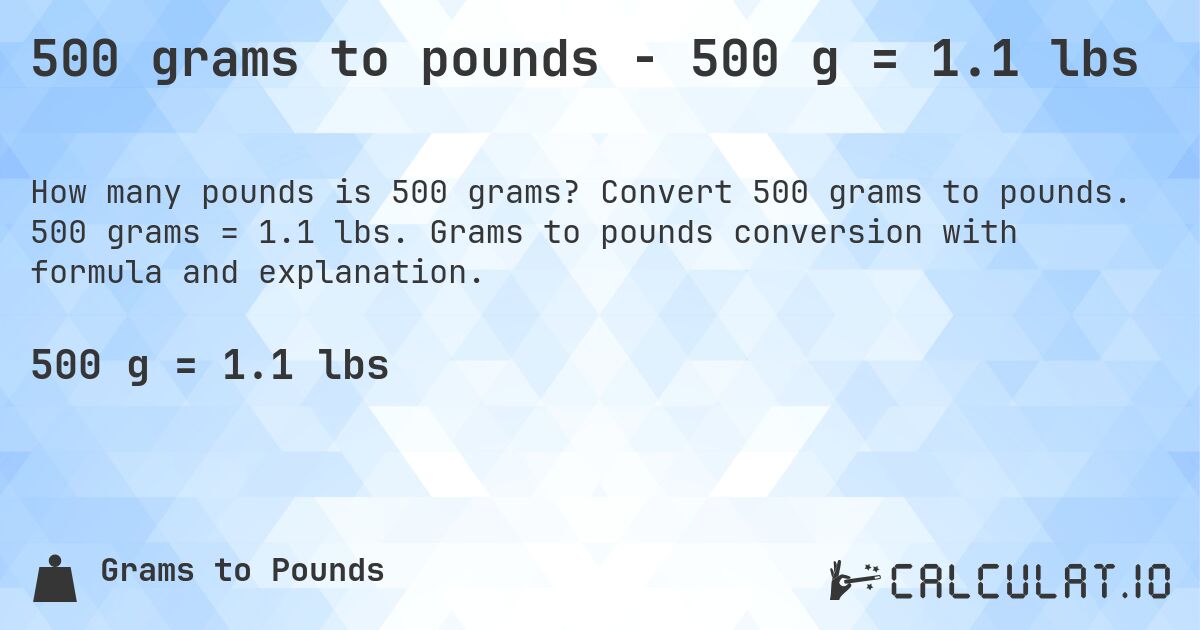
Converting 500 grams to pounds requires understanding the fundamental conversion factor: 1 pound (lb) = 453.59237 grams (g). This ratio was established through the 1959 international agreement between the US and UK to standardize the pound’s equivalence to the kilogram (1 kg = 2.20462 lbs). To convert grams to pounds, use the formula:
Mass in pounds = Mass in grams × (1 lb
Practical Applications of Converting 500 Grams to Pounds
Understanding the conversion between grams and pounds extends beyond theoretical knowledge—it directly impacts precision, compliance, and efficiency across industries, daily routines, and specialized fields. From culinary arts to pharmaceutical dosing, the ability to seamlessly switch between metric and imperial units ensures accuracy, reduces errors, and bridges communication gaps in global contexts. Whether adhering to international standards or catering to regional preferences, mastering this conversion empowers professionals and enthusiasts to navigate real-world challenges with confidence. The versatility of 500 grams to pounds (approximately 1.10231 pounds) serves as a critical reference point in scenarios where granularity matters. Below are structured applications where this conversion is indispensable, along with actionable tools and comparative analyses to optimize its use.
Real-World Scenarios Requiring 500 Grams to Pounds Conversion
Conversions between grams and pounds are not isolated to a single industry but are deeply embedded in processes where weight influences outcomes, safety, or cost. The following table outlines key scenarios where 500 grams to pounds plays a decisive role, categorized by industry, purpose, and practical examples.
Scenario Industry/Field Why Conversion Matters Example Calculation Baking and Pastry Ingredients Culinary Arts / Home Baking Recipes from metric-based countries (e.g., France, Japan) often list ingredients in grams, while U.S. bakers may prefer pounds. Precision in flour, sugar, or butter measurements directly impacts texture and taste. Supplement Dosage for Athletes Fitness / Bodybuilding Protein powders, creatine, and vitamins are typically measured in grams, but progress tracking (e.g., weight gain/loss) uses pounds. Misalignment can lead to incorrect dosage or misinterpreted results. Pharmaceutical Compounding Healthcare / Pharmacy Prescriptions may specify dosages in grams (e.g., compounded medications), but patient education or retail packaging often uses pounds or ounces. Accuracy is critical to avoid under/over-dosing. Shipping and Logistics Weight Limits E-commerce / Freight Carriers like FedEx or DHL use pounds for dimensional weight calculations, but product specifications (e.g., imported goods) may be listed in kilograms or grams. Exceeding weight limits incurs penalties or delays. Body Composition Analysis Fitness / Medical Fat loss or muscle gain is traditionally measured in pounds, but bioelectrical impedance scales may display results in grams or kilograms. Athletes and clients need to reconcile these metrics for coherent progress tracking. Manufacturing Tolerance Checks Industrial / Quality Control Production lines may operate in metric units, but client specifications (e.g., U.S. military contracts) require pounds. Deviations within ±500g can trigger rework or rejection. Creating a Conversion Cheat Sheet for Common Weights
A conversion cheat sheet serves as a quick-reference tool to minimize errors in fields where speed and accuracy are paramount. Below is a structured template for a cheat sheet that includes 500 grams to pounds alongside other high-utility conversions, designed for portability (e.g., printed or digital). Key Conversions to Include:
Metric to Imperial: 250g = 0.551 lbs 500g = 1.102 lbs 1kg = 2.205 lbs 2kg = 4.409 lbs Imperial to Metric: 1 lb = 453.59g 2 lbs = 907.18g 5 lbs = 2.268kg Design Tips:
Use a two-column format with metric units on the left and imperial on the right for side-by-side comparison. Highlight 500g to 1.10 lbs in a distinct color (e.g., red) for emphasis. Add a flowchart (described below) to guide unit selection based on context. Include scientific notation for precision-critical fields (e.g., 500g = 5.00 × 10² g = 1.10231 × 10⁰ lbs). Example Layout (Text-Based): +----------------+----------------+ | METRIC | IMPERIAL | +----------------+----------------+ | 250g | 0.55 lbs | | 500g | 1.10 lbs | ← Highlighted | 1kg | 2.20 lbs | | 2kg | 4.41 lbs | +----------------+----------------+
Fitness and Bodybuilding: Tracking Progress in Grams vs. Pounds
In fitness, the discrepancy between grams (supplements, food intake) and pounds (body weight) creates a dual-system challenge. Professionals mitigate this by standardizing tracking methods, often using conversion benchmarks like 500 grams to pounds to align nutritional data with physical progress. Common Practices:
Supplement Logging: Bodybuilders document protein intake in grams (e.g., 500g whey protein per week) but correlate it with weekly weight fluctuations in pounds. Example: A lifter consuming 500g of protein daily (~1.10 lbs) tracks whether this intake supports a 1 lb/month gain goal. Body Composition Reconciliation: Scales displaying grams (e.g., smart scales) require manual conversion to pounds for traditional progress charts. Example: A client losing 500g (1.10 lbs) in a week may interpret this as "off-target" if their goal is 2 lbs/week without conversion. Macronutrient Scaling: Fitness apps (e.g., MyFitnessPal) default to grams for food logging but allow pound-based calorie targets. Users must cross-reference: 500g rice ≈ 1.10 lbs → 2000 kcal (varies by type). Adjusting portion sizes from grams to pounds ensures cal Tools and Methods for Accurate Conversion of 500 Grams to Pounds
Accurate conversion between grams and pounds is critical in fields ranging from culinary arts to engineering, where precision directly impacts outcomes. Whether relying on mental calculations, digital tools, or physical references, the method chosen must align with the task’s demands for speed, reliability, and consistency. This section explores manual techniques for quick estimations, evaluates digital tools for high-accuracy conversions, and examines practical strategies to mitigate common errors, emphasizing the role of unit consistency in professional settings.
Manual Calculation Techniques for 500 Grams to Pounds
Manual conversion of 500 grams to pounds can be achieved through mental math or written calculations, leveraging the conversion factor 1 pound ≈ 453.592 grams. For practical applications where digital tools are unavailable, breaking down the conversion into simpler steps enhances accuracy and efficiency. One effective approach involves proportionate scaling. Since 453.592 grams equals 1 pound, dividing 500 grams by 453.592 yields approximately 1.1023 pounds. To simplify this further, recognize that 450 grams is roughly 0.992 pounds (450 ÷ 453.592), leaving an additional 50 grams (≈ 0.1102 pounds). Summing these values gives 1.099 pounds, a close approximation to the precise value. For quicker mental estimations, rounding 453.592 to 454 grams per pound reduces the calculation to 500 ÷ 454 ≈ 1.101 pounds, introducing a minor error of 0.0013 pounds (≈ 0.6 grams), acceptable for informal contexts like cooking or general measurements. For those preferring written calculations, the formula:
grams ÷ 453.592 = pounds
can be applied systematically. For example: 1. Divide 500 by 453.592 using long division to isolate the decimal. 2. Multiply the result by 16 (ounces per pound) to convert to ounces if finer granularity is needed, then divide by 16 to return to pounds. 3. Cross-validate with the inverse conversion: 500 grams × (1 pound / 453.592 grams) ≈ 1.1023 pounds.
Digital Tools for High-Accuracy Conversion
Digital tools eliminate human error and offer features like batch processing, historical tracking, and offline functionality. The most reliable options include online converters, mobile applications, and spreadsheet functions, each tailored to specific use cases. Below is a comparative analysis of leading tools, balancing accuracy, usability, and supplementary features.
Tool Accuracy Level Ease of Use Additional Features UnitConverters.net High (15+ decimal places) 5/5 (Intuitive UI, no ads) Batch conversion, customizable units, API access Google’s Unit Converter (Search) Medium (4-6 decimal places) 5/5 (Instant, no installation) Integration with Google Assistant, supports 100+ units Excel/Google Sheets (CONVERT function) High (limited by spreadsheet precision) 4/5 (Requires formula knowledge) Automated batch processing, data visualization, scriptable via VBA/Google Apps Script UnitConverter App (Android/iOS) High (adjustable precision) 5/5 (Offline mode, widget support) Custom unit libraries, conversion history, widget for quick access Python’s `unitconverter` Library High (library-dependent) 3/5 (Requires coding knowledge) Scriptable for automation, supports SI and imperial units, error handling Online converters like UnitConverters.net prioritize precision with minimal user input, making them ideal for one-off conversions. Google’s search-based converter excels in accessibility but may lack granularity for scientific applications. Spreadsheet functions (e.g., `=CONVERT(500,"gm","lb")` in Google Sheets) are indispensable for data-driven workflows, enabling bulk conversions and integration with other calculations. Mobile apps provide offline capabilities and widget integration, crucial for fieldwork or travel, while programmable libraries (e.g., Python’s `unitconverter`) offer flexibility for developers embedding conversions into larger systems.
Programming a Conversion Function in Python and JavaScript
For users requiring customizable or automated conversions, programming a function in Python or JavaScript ensures reproducibility and adaptability. Below are implementations for both languages, including input validation to handle non-numeric or negative values. Python Example: def grams_to_pounds(grams): """Convert grams to pounds with error handling.""" try: grams = float(grams) if grams
< 0: raise ValueError("Input must be non-negative.") return round(grams / 453.59237, 6) # Rounded to 6 decimal places except (ValueError, TypeError) as e: return f"Error: {e}. Please enter a valid number."Usage:
print(grams_to_pounds(500)) # Output: 1.10231 JavaScript Example: function gramsToPounds(grams) { / Convert grams to pounds with error handling. */ if (typeof grams !== 'number' || grams
< 0) { throw new Error("Input must be a non-negative number."); } return Math.round((grams / 453.59237) * 1e6) / 1e6; // Rounded to 6 decimal places } // Usage: console.log(gramsToPounds(500)); // Output: 1.10231 Key considerations for these functions include:Precision handling: Rounding to 6 decimal places balances readability and accuracy for most applications.
Error handling: Validating inputs prevents crashes from invalid data (e.g., strings or negative numbers). Scalability: Functions can be extended to support batch conversions or additional units (e.g., kilograms, ounces). Designing a Physical Conversion Reference Card
A portable conversion reference card serves as a backup for digital tools or in environments where screens are impractical. To create an effective card for 500 grams to pounds and other key conversions, follow these design principles: 1. Layout and Hierarchy:
Place the 500 grams to pounds conversion (≈1.102 lbs) prominently at the top, using a larger font (e.g., 14pt) for immediate visibility. Group related conversions (e.g., grams to ounces, kilograms to pounds) in columns or sections with clear headers. Use color-coding: Highlight critical conversions (e.g., 500g, 1kg) in a distinct color (e.g., red or green) to draw attention. 2. Key Conversions to Include:
Metric to Imperial: 100g, 250g, 500g, 1kg to pounds/ounces. Imperial to Metric: 1 lb, 2 lbs, 16 oz to grams/kilograms. Volume-Weight Equivalents: 1 cup flour ≈ 120g, 1 cup sugar ≈ 200g (common in cooking). Scientific Prefixes: milli-, centi-, kilo- conversions for grams. 3. Readability Tips:
Font: Use sans-serif fonts (e.g., Arial, Helvetica) for clarity on laminated cards. Spacing: Maintain 1.5x line spacing Cultural and Regional Perspectives on Weight Measurements
The interplay between grams and pounds extends beyond mere mathematical conversions—it reflects cultural identity, historical legacies, and global trade dynamics. While the metric system dominates in most of the world, pockets of resistance and hybrid usage persist, revealing how deeply embedded these units are in daily life. From the kitchen tables of British bakers to the bustling markets of Myanmar, the choice between grams and pounds often mirrors regional pride, practical necessity, or colonial heritage. This exploration examines how weight measurements are perceived, taught, and depicted across cultures, tracing their roots to historical trade and modern-day media influence.
Global Adoption Patterns of Grams and Pounds
The metric system, with its gram-based measurements, is the official standard in 95% of the world’s nations, yet exceptions and transitional phases persist. Countries like Canada, Liberia, and Myanmar officially recognize both metric and imperial systems, creating a fascinating blend of old and new. Canada, for instance, adopted the metric system in 1971 but retains imperial units in everyday contexts, such as road signs (miles per hour) and weather forecasts (Fahrenheit). Liberia, one of the last holdouts of the imperial system, uses pounds for trade and official documents despite global pressure to metricate. Meanwhile, Myanmar (formerly Burma) operates under a hybrid system where grams and pounds coexist in markets, reflecting its unique colonial history under British rule. In Europe, the metric system is nearly universal, yet the United Kingdom stands out as a bastion of imperial resistance in certain sectors. British bakers, for example, often measure ingredients in pounds rather than grams, citing tradition and the precision of imperial units for tasks like dough scaling. A 2018 survey by the British Bakers’ Association found that 68% of professional bakers preferred pounds for flour and sugar, arguing that imperial measurements aligned better with their inherited recipes. Similarly, the United States—the only industrialized nation not fully metricated—relies on pounds for commerce, medicine, and aviation, despite scientific communities advocating for metric consistency.
Cultural Attitudes Toward Metric and Imperial Measurements
Cultural attitudes toward measurement systems often hinge on nostalgia, practicality, and national identity. In France, the birthplace of the metric system, resistance to imperial units is minimal, yet regional variations persist. For example, cheese producers in Normandy sometimes use traditional weights tied to local dialects, where terms like "livre" (a pre-metric unit) linger in colloquial speech. Conversely, in Australia, where metrication was enforced in the 1970s, older generations occasionally default to pounds for body weight or meat purchases, reflecting a generational divide. In India, the metric system is official, but traditional units like the ser (for gold) or man (for grains) remain in rural markets. A 2020 study by the Indian Council of Social Science Research noted that 42% of rural traders in Punjab still used hybrid measurements, blending grams with older units for customer familiarity. The persistence of these systems underscores how language and tradition shape measurement preferences. Even in fully metricated nations, misconceptions persist: a 2019 poll in Germany revealed that 30% of respondents incorrectly estimated that 500 grams was equivalent to "about half a kilogram," highlighting gaps in everyday metric literacy.
Language and Terminology in Weight Measurements
The terminology for weight varies dramatically across languages, often carrying cultural or historical weight. Below is a comparison of how "500 grams" and "1 pound" are expressed in five major languages, illustrating linguistic diversity in measurement communication:
Language 500 Grams 1 Pound Spanish (Spain) quinientos gramos (or colloquially, "medio kilo") una libra (formal); "libra" in culinary contexts Mandarin Chinese 五百克 (wǔbǎi kè) (metric standard); "半斤 (bàn jīn)" in older contexts (1 jin ≈ 500g) 一磅 (yī bàng) (imperial, used in trade) Arabic (Modern Standard) خمس مئة غرام (khamsa mi’a grām); "نصف كيلوغرام (nafs kilū)" رطل (raṭl) (from Latin libra; persists in Gulf markets) Hindi पांच सौ ग्राम (pāñch sau grām); "अधिक किलो (adhik kilo)" in informal speech एक पाउंड (ek pāūṇḍ) (used in fitness/imported goods) Portuguese (Brazil) quinhentos gramas; "meio quilo" (common slang) uma libra (rare in daily life; appears in aviation or imported labels) The evolution of these terms reflects colonial influence (e.g., libra in Arabic from Latin) and modern globalization (e.g., pound in Hindi for fitness trends). In Japan, the metric system is strict, yet traditional units like kan (for rice, ~3.75kg) persist in agriculture, demonstrating how sector-specific needs dictate measurement language.
Educational Approaches to Teaching Weight Measurements
How weight is taught in schools varies widely, often mirroring a country’s measurement culture. In metric-dominant nations like France or Sweden, children learn grams and kilograms as early as age 5, with hands-on activities like weighing fruits or toys. A Grade 3 curriculum example in France might include:
Activity: Weighing a loaf of bread (250g) and comparing it to a 1kg bag of sugar. Vocabulary: "Un gramme est égal à un millième de kilogramme." Real-world link: Discussing nutrition labels on cereal boxes. In contrast, U.S. schools introduce pounds and ounces in Grade 2, often through cooking or sports (e.g., measuring ingredients for muffins or tracking weightlifting progress). A Texas Essential Knowledge and Skills (TEKS) standard for Grade 4 requires students to:
Convert between ounces and pounds (e.g., 16 oz = 1 lb). Solve word problems like "If a turkey weighs 20 pounds, how many 5-pound bags can be made?" Canada’s dual-system education presents a unique challenge. In Ontario, students learn both metric and imperial units, with Grade 5 lessons focusing on:
Conversion practice: "500 grams ≈ 1.1 pounds" (rounded for simplicity). Cultural relevance: Discussing how Canadian weather forecasts use Celsius but road signs use miles per hour. Media and Pop Culture Depictions of Weight Conversions
Media often reinforces—or subverts—measurement norms, sometimes with humorous results. In British television, the 2010s sitcom "The Inbetweeners" featured a running gag where characters struggled with metric conversions, culminating in a scene where they mistakenly believed 1kg was "heavy" because they associated it with pounds. Meanwhile, American films frequently use pounds for dramatic effect: in "The Hangover" (2009), the infamous "pound cake" scene plays on the unit’s cultural familiarity, despite the metric system being standard in baking science. Advertisements also highlight measurement confusion. A 2017 McDonald’s campaign in the UK advertised a "1lb burger" (≈453g) to appeal to traditionalists, while their European counterparts used grams. In India, Fitness influencers often switch between kilograms and pounds when discussing weight loss, creating inconsistency for viewers. Even video games reflect this duality: "The Sims" series allows players to toggle between metric and imperial units, while "Call of Duty" maps in multiplayer modes list ammunition weights in
Advanced Topics in Precision, Science, and Special Cases for 500 Grams to Pounds Conversion
The conversion of 500 grams to pounds transcends basic arithmetic in fields where precision, scientific rigor, and industry-specific standards demand exactitude. From pharmaceutical formulations to aerospace engineering, the implications of even minor measurement discrepancies can lead to catastrophic failures or costly errors. This section explores the nuanced roles of significant figures, high-stakes applications, and environmental influences on weight conversions, alongside specialized industries where metric and imperial systems intersect in non-negotiable ways.
Significant Figures and Precision in Weight Conversion
The concept of significant figures dictates the level of precision required in measurements, directly impacting conversions like 500 grams to pounds. In contexts such as pharmaceutical manufacturing, a deviation of 0.1 grams in a 500-gram batch can alter drug potency, whereas in home cooking, such precision is irrelevant. The conversion 500 g ≈ 1.10231 pounds assumes ideal conditions, but real-world applications often require adjustments:
Pharmaceuticals: Measurements must adhere to ±0.01% tolerance, necessitating conversions rounded to 1.102 pounds (3 significant figures). Cooking: A ±5% variation (e.g., 1.047–1.157 pounds) is acceptable, as ingredients are rarely measured to the gram. Precision Engineering: Aerospace components may demand 5 decimal places (e.g., 1.10231 lbs), where even 0.00001 lbs affects structural integrity. Key Principle: Significant figures in conversions depend on the criticality of the application. Pharmaceuticals and aerospace use 4–6 significant figures, while general use tolerates 2–3.
Case Study: 500 Grams to Pounds in Space Exploration
NASA’s Artemis program and SpaceX’s Starship missions rely on metric-to-imperial conversions for fuel mass, cargo payloads, and propulsion systems. A 500-gram discrepancy in propellant calculations could mean the difference between orbital insertion success and mission failure. For example:
Fuel Mass Calculation: A 500 kg (≈1,102.31 lbs) propellant tank must account for thermal expansion (weight shifts due to temperature) and gravitational variance (Moon vs. Earth). Engineers convert 500 grams of hydrazine fuel to 1.10231 lbs but adjust for microgravity effects, where buoyancy alters apparent weight. Cargo Payloads: The International Space Station (ISS) uses kilograms for internal logistics but pounds for launch vehicle specifications. A 500-gram science experiment must be cross-verified as 1.102 lbs to ensure compatibility with Dragon or Cygnus spacecraft weight limits. Historical Lesson: The Mars Climate Orbiter (1999) failed due to a metric-imperial mix-up, costing $327 million. Post-mortem analyses revealed that 500-gram thrusters were miscalculated as 1.102 lbs instead of 1.102 kg·f (kilogram-force), proving that unit consistency in space is non-negotiable. Niche Industries Where 500 Grams to Pounds Conversions Are Critical
Certain industries operate within hyper-specific weight standards where 500 grams to pounds must be converted with industry-defined tolerances. Below are sectors where errors are operationally or legally catastrophic:
- Jewelry Manufacturing Precision scales measure gold, platinum, and diamonds in troy ounces (≈31.1035 g) and troy pounds (≈373.242 g). A 500-gram gold bar (≈16.22 troy lbs) must be verified to ±0.001 troy oz to avoid fines or fraud. The karat-purity system (e.g., 24K = 99.9% pure) relies on gram-to-pound conversions scaled to 0.0001 lbs for accuracy.
- Textile and Yarn Production Yarn weight is classified by tex (grams per kilometer) or denier (grams per 9,000 meters). A 500-gram spool of cotton yarn (≈1.102 lbs) must be converted to denier for weaving patterns. Misconversion can lead to fabric strength failures or waste in luxury textiles (e.g., Hermès silk scarves).
- Automotive Precision Engineering Car manufacturers use grams for electronics (e.g., 500-gram battery packs ≈ 1.102 lbs) but pounds for structural components (e.g., 1,500-lb chassis). A 0.5% error in converting 500 grams of carbon fiber to 1.102 lbs can affect crash-test performance or fuel efficiency calculations.
- Aerospace Avionics Circuit boards and sensors are specified in grams, but FAA/EASA regulations require pound-based weight declarations. A 500-gram avionics module (≈1.102 lbs) must be documented with ±0.01 lb tolerance for flight certification.
Converting 500 Grams to Pounds in Non-Base Units
Direct conversion from grams to pounds assumes a 1:2.20462 ratio, but real-world applications often require intermediate steps involving ounces, kilograms, or other derived units. Below are practical conversion pathways:
- Grams → Ounces → Pounds
- 500 g ÷ 28.3495 g/oz ≈ 17.637 oz
- 17.637 oz ÷ 16 oz/lb ≈ 1.10231 lbs
Use case: Baking recipes (e.g., converting European flour measurements to US pounds).- Kilograms → Pounds (Scaling Up)
- 500 g = 0.5 kg
- 0.5 kg × 2.20462 lbs/kg ≈ 1.10231 lbs
Use case: Logistics and shipping, where metric tons (1,000 kg) are converted to short tons (2,000 lbs) for US customs.- Grams → Troy Pounds (Jewelry)
- 500 g ÷ 373.242 g/troy lb ≈ 1.339 troy lbs
Use case: Precious metal trading, where troy pounds are the standard.Environmental Factors Affecting Gram vs. Pound Measurements
Weight is not an absolute value—humidity, temperature, and air pressure introduce apparent weight variations that complicate 500-gram-to-pound conversions. In scientific experiments, these factors must be controlled:
- Humidity and Buoyancy
- Moisture absorption: A 500-g paper sample in 90% humidity may weigh 510 g due to water absorption, altering its 1.102-lb equivalent.
- Air density: At high altitudes (e.g., Denver, CO), air buoyancy reduces apparent weight by 0.3% compared to sea level. A 500-g object may register as 498.5 g, requiring 1.097-lb adjustment.
- Temperature Effects on Materials
- Thermal expansion: Aluminum expands 0.023% per °C. A 500-g rod at 20°C may shrink to 499.8 g at 100°C, affecting 1.102-lb calculations.
- Phase changes: Water freezes at 0°C, increasing density by 9%—500 g of liquid water becomes 545 g of ice, requiring 1.202-lb recalibration.
- Scientific Instrument Calibration
- Analytical balances (used in pharmaceuticals) must account for
Creative and Interactive Approaches to Mastering 500 Grams to Pounds Conversions
Mastering weight conversions like 500 grams to pounds (approximately 1.1023 pounds) requires engagement beyond rote memorization. Interactive and creative methods enhance retention by transforming abstract numerical relationships into tangible, relatable experiences. These approaches cater to diverse learning styles—visual, auditory, kinesthetic—and adapt to different age groups, from children to adults refining their quantitative skills. By integrating gamification, hands-on activities, and digital tools, learners can develop accuracy, confidence, and a deeper understanding of metric and imperial weight systems.Interactive Quiz and Game-Based Learning
Gamified quizzes reinforce conversions through immediate feedback and competitive engagement. A well-structured quiz can include multiple-choice questions, fill-in-the-blank exercises, and real-world scenario challenges to test practical application. Multiple-Choice Questions assess foundational knowledge with options like:- "500 grams is equivalent to approximately:"
- A) 0.5 pounds
- B) 1.1 pounds
- C) 2.2 pounds
- D) 3.3 pounds
Correct answer: B) 1.1 pounds (rounded to one decimal place). Fill-in-the-Blank Conversions encourage active recall:- "Convert 500 grams to pounds: ___ lbs (use 1 gram ≈ 0.00220462 lbs)."
Answer: 1.1023 lbs (or 1.1 lbs for simplicity). Real-World Scenario Challenges bridge theory to practice:- "A chef uses 500 grams of flour for a recipe. How many pounds is this? What if the recipe calls for 1.1 lbs of sugar instead? Would the amounts be equivalent?"
Solution: Both are equivalent when rounded, but exact precision matters in baking where 500g = 1.1023 lbs vs. 1.1 lbs. For educators or self-learners, platforms like Kahoot!, Quizizz, or Google Forms can host these quizzes with customizable difficulty levels. Leaderboards and timers add urgency, while explanations for incorrect answers clarify misconceptions.DIY Conversion Kit Using Household Items
A hands-on conversion kit demystifies weight relationships by leveraging everyday objects. This kit requires minimal materials: a kitchen scale (measuring grams and pounds), measuring cups, a notebook, and small containers (e.g., plastic cups or jars). Step-by-Step Assembly: 1. Calibrate the Scale: Ensure it measures in both grams and pounds. If not, use an online converter to cross-verify. 2. Measure 500 Grams: Fill a container until the scale reads 500g. Note the approximate volume (e.g., 2 cups of rice ≈ 250g, so 4 cups ≈ 500g). 3. Convert to Pounds: Weigh the same container on the pounds setting. Record the result (~1.1 lbs). 4. Compare Objects: Use toys (e.g., a standard deck of cards weighs ~120g) or snacks (e.g., a medium apple ≈ 180g) to build up to 500g physically. 5. Document Findings: Sketch or photograph the process in the notebook, labeling each step with weights in grams and pounds. Example Activity:- "If a bag of sugar is labeled 500g, how many 1-pound bags would you need to match its weight?"
Answer: 0.907 bags (since 500g ≈ 1.1 lbs < 1 lb). This tactile method reinforces that 500g is heavier than a pound by a small margin, addressing common misconceptions.Printable Worksheets and Flashcards for Practice
Structured worksheets and flashcards provide repetitive practice essential for mastery. Below are template designs with self-checking answers, optimized for printability. Worksheet Template: "Convert and Compare"Instructions: Fill in the pounds column using the conversion factor 1 lb ≈ 453.592g. Verify answers with a calculator or the provided key. Flashcard Design:
Grams (g) Pounds (lbs) Real-World Item 250 0.55 Half a liter of water 500 1.10 Loaf of bread 1000 2.20 Small bag of flour - Front: "500g = ___ lbs"
- Back: "1.1023 lbs (or 1.1 lbs rounded)" + icon of a kitchen scale.
- Variation: Use images (e.g., a banana ≈ 120g) to prompt conversions.
Pro Tip: Laminate flashcards for durability or use them digitally via apps like Quizlet or Anki for spaced repetition.Teaching 500 Grams to Pounds to Children: Age-Appropriate Activities Children learn best through play and sensory exploration. For ages 5–8, focus on visual and kinesthetic methods:- Snack Math: Use goldfish crackers (≈1g each) to count out 500 pieces, then group them into "pound bundles" (454 crackers ≈ 1 lb).
- Art Project: Create a weight mural with drawings of objects labeled in grams and pounds (e.g., a pencil ≈ 10g, a textbook ≈ 1 lb).
- Storytelling: Invent a tale where a character needs to carry 500g of "magic berries" (use dried beans) to a castle, comparing their weight to a toy sword (~0.5 lbs).
For ages 9–12, introduce measurement tools and simple equations:- Science Experiment: Weigh a raw egg (~50g) and calculate how many eggs make 500g (10 eggs ≈ 500g). Convert to pounds (~1.1 lbs).
- Board Game: Design a path where players move based on weight conversions (e.g., "Take 3 steps if you correctly convert 500g to pounds").
Augmented and Virtual Reality for Immersive Learning
AR and VR transform abstract conversions into spatial, interactive experiences. Tools like Google’s ARCore, Unity, or CoSpaces enable learners to visualize and manipulate weights dynamically. AR Application Example: 1. Scan a Real Object: Use an AR app to scan a household item (e.g., a bag of sugar) and overlay its weight in grams and pounds. 2. Interactive Scale: Place a virtual scale on a table. Drag and drop objects (e.g., a watermelon) to see their weight displayed in both units. 3. Gamified Challenges: AR games like "Measure Mania" (hypothetical) could task players with sorting objects by weight, converting between units in real time. VR Simulation Ideas:- Baking Lab: A virtual kitchen where users must measure 500g of flour and compare it to the required pounds, receiving feedback on accuracy.
- Space Mission: Astronauts on Mars (where gravity affects weight) must convert cargo weights between Earth’s metric system and imperial units.
Accessibility Note: Free or low-cost tools like Merge EDU (AR) or Google Expeditions (VR) can be adapted for classroom use without advanced technical skills.Recommended Educational Resources for Weight Conversions
Curated multimedia resources accelerate learning through diverse formats. Below are YouTube channels, podcasts, and videos with key takeaways:
Resource Format Key Takeaway Best For Khan Academy (YouTube) Video Tutorial Step-by-step conversion with visual aids (e.g., balancing scales). Beginners, visual learners. Crash Course Kids Animated Series Episode on "Measurement" covers grams vs. pounds with memorable metaphors. Ages 6–12. TED-Ed Lessons Animated Lessons "The Metric System Explained" includes conversion examples. General audience. The Organic Chemistry Tutor Video Series Focuses on unit conversions with practice problems (e.g., "Convert 500g to lbs"). Students/self-learners. Brains On! (Podcast) Audio Episode Understanding how 500 grams translates to pounds isn’t just about memorizing a number—it’s about navigating a world where measurement systems collide. From the precision demands of a laboratory to the rough estimates of a home chef, the ability to convert accurately ensures consistency, safety, and efficiency. Whether you rely on mental math, digital tools, or a trusty cheat sheet, the key lies in context: knowing when to prioritize exactness and when an approximation suffices. As global trade tightens and digital tools democratize conversions, the divide between grams and pounds shrinks—but mastery remains essential. The next time you face this conversion, remember: it’s more than arithmetic; it’s a bridge between systems that have shaped human progress for centuries.
Leave a Comment
Comments are moderated before appearing. The data you submit is processed according to the Privacy Policy of Vetlife Archive.